Industrial Paint Markers for the Precast Concrete Industry: Choosing the Right Marker for Every Surface and Condition
The precast concrete industry depends on clear, durable markings to maintain quality control, improve production efficiency, and ensure accurate identification throughout manufacturing, storage, transportation, and installation. From marking concrete forms and finished panels to identifying embedded components, dimensions, inspection points, and job numbers, industrial paint markers are essential tools in precast concrete operations.
However, not all markers perform equally well in the demanding environments where precast concrete products are manufactured and stored. Surface texture, weather exposure, temperature, and color visibility all play an important role in selecting the right marker for the job.
MarkingPenDepot.com offers a wide selection of industrial paint markers in multiple styles and colors, making it an ideal supplier for precast concrete manufacturers seeking reliable marking solutions.
Solid Paint Markers for Rough Concrete Surfaces
Precast concrete production involves many rough, porous, and abrasive surfaces. Conventional felt-tip markers can struggle to deliver consistent marks on unfinished concrete, textured surfaces, and other irregular materials.
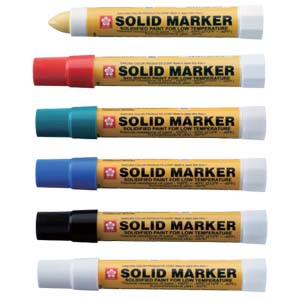
Solid paint markers are often the preferred solution for these applications.
Unlike liquid paint markers that dispense paint through a felt tip, solid paint markers use a solid paint-like marking material that deposits color as it is applied to a surface. Their design makes them particularly useful when marking rough concrete, masonry, and other challenging materials.
Common applications for solid paint markers in the precast concrete industry include:
-
Identifying concrete panels: Mark panel numbers, production codes, job numbers, and installation sequences.
-
Quality control inspections: Identify areas requiring additional inspection, correction, or repair.
-
Marking forms and molds: Provide temporary identification and production information where appropriate.
-
Tracking embedded components: Mark locations associated with lifting inserts, hardware, and other installation features.
-
Warehouse and yard identification: Help distinguish individual products during outdoor storage and staging.
Solid paint markers are available in different colors, allowing production personnel to establish a consistent color-coding system for different products, inspection stages, or work assignments.
When choosing a solid paint marker, consider the roughness of the surface, the required line width, the visibility of the marking, and whether the mark needs to remain visible temporarily or for an extended period.
Felt-Tip Paint Markers for Smooth Concrete and Finished Surfaces
Not every precast concrete surface is rough. Smooth architectural panels, finished concrete products, coated components, and metal hardware may require a more precise marking method.
Felt-tip paint markers are well suited to these applications because they offer controlled paint delivery and more defined lines than many solid paint markers.
Depending on the marker design and tip size, felt-tip markers can be used for:
-
Writing part numbers, dimensions, and production codes.
-
Applying inspection marks to smooth concrete surfaces.
-
Identifying finished architectural precast components.
-
Marking metal inserts, brackets, and associated hardware.
-
Adding clear identification marks where legibility and precision are important.
Felt-tip paint markers are available in different tip sizes and colors, allowing operators to select the appropriate combination for the marking task.
For the best results, choose a marker formulated for the specific surface being marked. Smooth concrete may still be porous, dusty, damp, or treated with a curing compound or sealer, all of which can affect paint adhesion and drying. Testing the marker on a representative surface is a practical way to verify performance before using it throughout production.
UV Resistance: An Important Factor for Outdoor Precast Concrete
Many precast concrete products spend considerable time outdoors before shipment or installation. Finished panels, structural components, steps, barriers, and other products may be exposed to direct sunlight for days, weeks, or longer.
This exposure makes ultraviolet (UV) resistance an important consideration when selecting industrial markers.
UV radiation can cause certain pigments and marking materials to fade over time. A mark that is initially bright and easy to read may become difficult to distinguish after prolonged exposure to sunlight.
Fading can create practical problems, including:
-
Difficulty identifying panels and individual components.
-
Reduced visibility of inspection and quality-control marks.
-
Confusion during inventory management and shipment preparation.
-
Additional labor spent verifying product identification.
For outdoor applications, select markers with demonstrated resistance to fading under the expected exposure conditions. Bright colors can improve visibility, but brightness alone does not guarantee UV resistance.
The required level of durability will depend on how long the marking must remain legible, the amount of direct sunlight exposure, the color selected, and the surface being marked.
When markings must remain readable for extended periods, evaluate the manufacturer's performance information and test the selected marker under representative outdoor conditions.
Low-Temperature Performance in Precast Concrete Operations
Temperature is another critical consideration for precast concrete manufacturers.
Concrete products may be manufactured, stored, or handled in unheated facilities and outdoor yards where temperatures can drop significantly during colder months. Markers that perform well in a warm production environment may not deliver the same results in cold conditions.
Low temperatures can affect paint flow, drying time, adhesion, and the consistency of the mark. Some marking materials may become harder to apply, while certain liquid formulations may take longer to dry.
Selecting markers designed for the expected operating conditions can help maintain dependable marking performance throughout the year.
When evaluating markers for low-temperature applications, consider:
-
Application temperature: The minimum temperature at which the manufacturer recommends applying the marker.
-
Surface temperature: The concrete or component may be colder than the surrounding air.
-
Drying time: Cold conditions can extend the time required for a marking to dry.
-
Adhesion and durability: Verify that the marking remains legible and adheres adequately after application.
-
Storage requirements: Follow the manufacturer's recommendations for storing markers during cold weather.
It is important to distinguish between a marker that can be applied at low temperatures and one that can withstand cold temperatures after the paint has dried. These are separate performance characteristics.
For operations that work outdoors year-round, testing markers during actual winter conditions can help prevent production delays and identification problems.
Why Color Selection Matters in Precast Concrete Manufacturing
Color is more than a matter of preference in an industrial marking system. It can be an important part of production organization, quality control, and inventory management.
Using multiple marker colors allows precast concrete manufacturers to create a consistent visual identification system across their operations.
For example, a manufacturer might designate different colors for inspection status, product categories, shipping sequences, or specific production tasks. The exact system should be established internally and communicated clearly to production personnel.
A broad selection of colors is particularly useful when marking different concrete finishes, aggregate colors, and component materials. A color that stands out clearly on light-gray concrete may be difficult to see on darker concrete or metal surfaces.
When choosing colors, consider:
-
Contrast against the concrete or component surface.
-
Visibility in outdoor sunlight and shaded storage areas.
-
The intended duration of the marking.
-
Whether different departments or production stages use standardized color codes.
-
The need to distinguish markings from permanent product features.
Always ensure that color-coding systems are documented and that important safety or quality-control information does not rely on color alone.
Matching the Marker to the Application
The best marker depends on the combination of surface, environmental conditions, and marking requirements.
| Application | Marker type to consider | Key selection factors |
|---|---|---|
| Rough, unfinished concrete | Solid paint marker | Surface coverage, durability, line visibility |
| Smooth or finished concrete | Felt-tip paint marker | Precision, paint adhesion, tip size |
| Outdoor storage yards | UV-resistant formulation | Fade resistance, weather exposure |
| Cold-weather production | Cold-temperature-capable marker | Application temperature, drying, adhesion |
| Product identification and inventory | Solid or felt-tip paint marker | Legibility, color contrast, required line width |
| Quality-control marking | Application-appropriate industrial marker | Visibility, consistency, marking durability |
These are general guidelines. Actual performance varies by product formulation, surface condition, and application technique.
Why Choose MarkingPenDepot.com for Precast Concrete Markers?
Precast concrete manufacturers often need several different marking solutions rather than a single marker that must handle every task.
A solid paint marker may be ideal for rough concrete, while a felt-tip paint marker may provide the precision needed for finished surfaces. Outdoor storage may require stronger UV resistance, while winter operations may call for a marker that performs reliably in low temperatures.
MarkingPenDepot.com offers a wide variety of industrial paint markers, styles, and colors to help precast concrete manufacturers match the marker to the application.
A broad product selection provides several advantages:
-
More choices for different surfaces: Find marking options for rough concrete, smoother finishes, and associated components.
-
A variety of colors: Support color-coded production, inspection, and inventory systems.
-
Application-specific selection: Compare different marker designs to meet the requirements of individual tasks.
-
A convenient industrial marking source: Source marking products for multiple applications from one specialized supplier.
Rather than selecting a marker based on color or price alone, precast concrete manufacturers can evaluate the surface, required marking life, outdoor exposure, and operating temperature to identify the most appropriate solution.
Find the Right Industrial Paint Markers for Your Precast Concrete Operation
Reliable marking helps precast concrete manufacturers maintain product identification, streamline material handling, and support quality-control procedures. Choosing the right marker can reduce illegible markings, improve visibility, and make day-to-day production operations more efficient.
Whether you need solid paint markers for rough concrete, felt-tip markers for smooth surfaces, multiple colors for production identification, or formulations suited to outdoor UV exposure and cold-weather conditions, selecting the correct product is essential.
Visit MarkingPenDepot.com to explore a wide variety of industrial paint markers and find marking solutions for the demanding requirements of the precast concrete industry.
MarkingPenDepot.com — Your source for industrial paint markers for demanding surfaces, production environments, and specialized marking applications.