Why You Shouldn't Use Just Any Marker on Stainless Steel
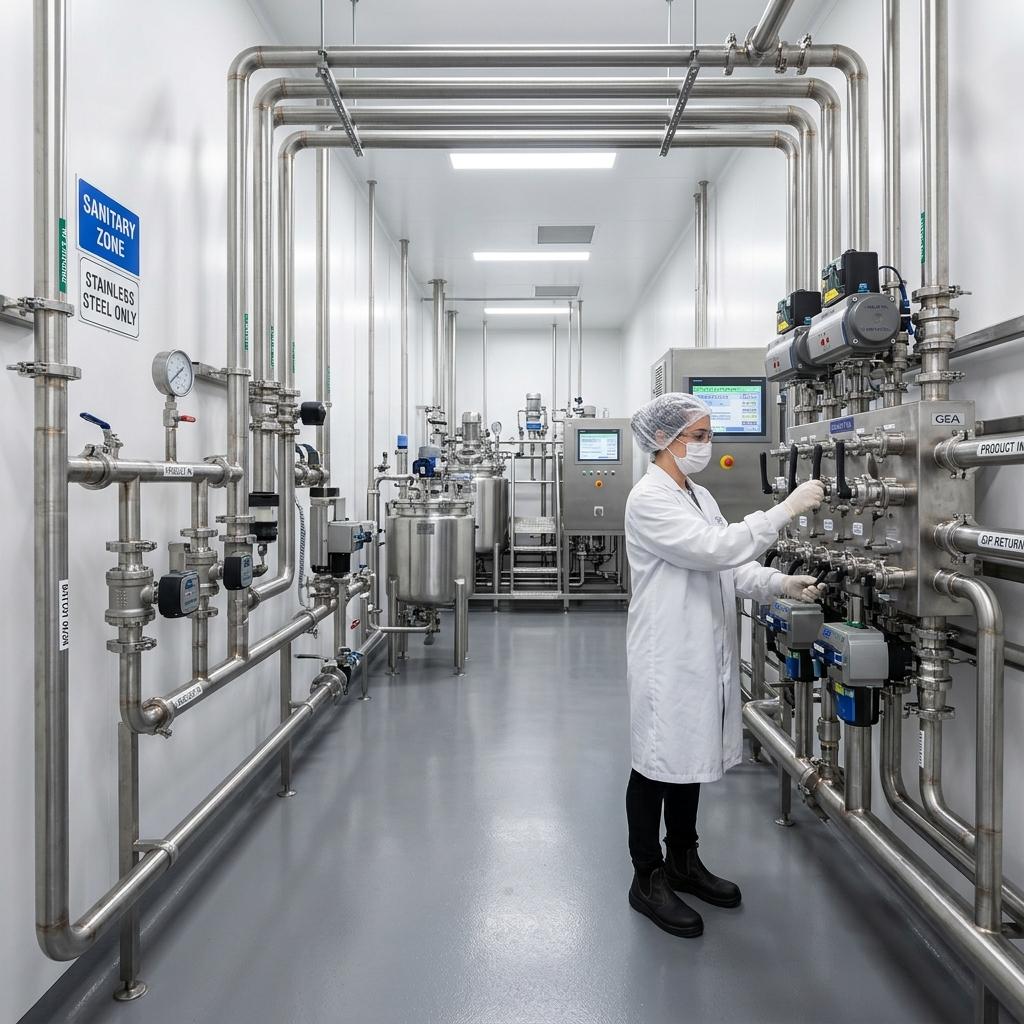
Stainless steel is built to withstand demanding environments. It's used in everything from food-processing equipment and pharmaceutical manufacturing to chemical plants, aerospace components, and industrial piping.
But here's something many people overlook: the marker you use on stainless steel can matter just as much as the mark itself.
A standard permanent marker or industrial paint marker might leave a perfectly visible line. However, in applications where corrosion, contamination, or material purity is a concern, using the wrong marking product could create problems you didn't anticipate.
That's why specialized low-chloride and low-halogen markers exist.
In this guide, we'll explain why stainless steel requires extra care, what chloride and halogen contamination mean, and how to choose the right industrial marker for your application. We'll also look at specialty products from DYKEM and Markal that are designed for demanding marking requirements.
Why Is Stainless Steel Different?
Stainless steel gets much of its corrosion resistance from a thin, protective chromium-rich oxide layer on its surface. This passive layer helps protect the underlying metal from rust and corrosion.
Although stainless steel is highly corrosion-resistant, it isn't completely immune to damage. Certain chemicals, environmental conditions, and contaminants can contribute to localized corrosion, including pitting and stress corrosion cracking under susceptible conditions.
One concern in sensitive industrial applications is contamination from substances that may be present in marking products.
Depending on their formulation, conventional markers can contain trace amounts of chlorides, other halogens, sulfur compounds, or certain metals. These ingredients aren't necessarily a problem for every application, but they can be unacceptable when working with stainless steel under strict material or process requirements.
For example, a component intended for a chemical-processing facility, nuclear power plant, or aerospace application may have specific requirements governing the materials that can contact its surface.
In these situations, selecting a marker isn't just about finding the right color or tip size. You also need to consider the marker's chemical composition and any required documentation.
What Are Chlorides, and Why Do They Matter?
Chlorides are chemical compounds containing chloride ions. In certain conditions, chloride contamination can contribute to localized corrosion of stainless steel, particularly pitting and crevice corrosion.
The risk depends on several factors, including the stainless steel grade, temperature, moisture, chloride concentration, and the surrounding environment.
This is especially important in applications involving:
-
Stainless steel piping and pressure systems.
-
Chemical processing and petrochemical facilities.
-
Nuclear and conventional power generation.
-
Aerospace manufacturing and maintenance.
-
Pharmaceutical and other high-purity manufacturing environments.
-
Stainless steel fabrication involving welding or other controlled processes.
For these applications, the residue left behind by a marking product may be subject to the same careful scrutiny as other materials used during manufacturing.
A marker that works perfectly well for general-purpose identification on ordinary steel may not meet the requirements for a particular stainless steel application.
The takeaway: Don't assume that a marker is suitable for critical stainless steel work simply because it writes well on metal. Check its specifications and confirm that it meets your project's requirements.
What Is a Low-Chloride or Low-Halogen Marker?
Low-chloride and low-halogen markers are designed for applications where controlling potentially corrosive contaminants is important.
Chlorine is one of the halogens. Other halogens include fluorine, bromine, and iodine. A low-chloride product focuses on limiting chloride content, while a low-halogen product addresses a broader group of elements.
Some specialized markers also control other potentially problematic substances, including sulfur and certain metals.
These products can be useful when marking stainless steel or other sensitive materials in environments where corrosion prevention and material compatibility are important.
However, there is an important distinction: the terms "low-chloride" and "low-halogen" do not automatically mean that a product meets every industry specification.
Different applications may have different limits and documentation requirements. If your job requires a particular standard, test report, certificate of conformity, or lot-specific chemical analysis, verify that the selected marker satisfies that requirement.
DYKEM High Purity Markers: For Critical Industrial Applications
DYKEM High Purity markers are designed for marking stainless steel and other surfaces where contamination, degradation, or adverse material effects are a concern.
Their formulations contain low levels of chlorides and trace amounts of halogens and low-melting-point metals. They are intended for applications where ordinary marking products may not satisfy the required material specifications.
DYKEM High Purity markers use a valve-action mechanism that helps control paint delivery and helps prevent the paint inside the barrel from drying out when the cap is left off. The standard felt-tip versions dry in approximately 45 seconds to one minute under suitable conditions.
Key features of DYKEM High Purity markers
-
Low-chloride formulation: Designed for applications where chloride contamination is a concern.
-
Controlled chemical composition: Contains trace amounts of halogens and low-melting-point metals.
-
Valve-action paint delivery: Helps maintain paint flow and usability.
-
Fast drying: Approximately 45 seconds to one minute under suitable conditions.
-
Multiple colors: Available in options including black, red, yellow, white, and blue.
-
Specialty applications: Suitable for stainless steel and other compatible surfaces in demanding industrial environments.
DYKEM High Purity markers are used in industries such as aerospace, marine, oil and gas, power generation, and nuclear facilities.
They are particularly worth considering when a project specifies a particular marking product or requires documentation demonstrating that the marker meets applicable material requirements.
Shop DYKEM High Purity and other low-chloride markers:
https://markingpendepot.com/lowchloridemarkers.aspx
Markal Low-Corrosion Markers: Another Option for Stainless Steel
DYKEM isn't the only manufacturer offering specialty markers for sensitive metal applications. Markal also offers low-corrosion marking products designed for stainless steel and other alloy metals.
These products are intended for applications where the marking material must meet specific limits for potentially problematic contaminants.
Two options worth considering are the Markal PAINT-RITER+ Certified marker and the Markal ST.2100 Tube Marker.
Markal PAINT-RITER+ Certified
The Markal PAINT-RITER+ Certified marker is a liquid paint marker designed for stainless steel and superalloys in applications where corrosion, pitting, and degradation are concerns.
Its formulation is designed to contain low levels of total halogens, sulfur, and low-melting-point metals. Markal provides individual batch analysis and certification for this product, which can be particularly valuable when quality-control procedures require supporting documentation.
Key features include:
-
A highly visible liquid paint mark.
-
A formulation designed for low levels of halogens, sulfur, and low-melting-point metals.
-
Fast-drying paint that resists wear, weather, and UV exposure.
-
Multiple color options.
-
Documentation to help users verify compliance with applicable requirements.
Markal identifies applications in nuclear power generation, other power generation facilities, oil and gas, military, welding, aviation, and aerospace.
For customers who need a liquid paint marker with documented chemical limits, PAINT-RITER+ Certified is an option worth evaluating against the project's requirements.
Markal ST.2100 Tube Marker
The Markal ST.2100 is another option for low-corrosion marking on stainless steel and alloy metals.
Unlike a conventional felt-tip marker, it uses a metal-ball tip and an aluminum squeeze tube containing thicker paint. This design is useful when applying marks to vertical or overhead surfaces where paint control matters.
The ST.2100 formulation is designed to contain low levels of halogens, sulfur, and low-melting-point metals. Markal publishes a typical analysis indicating less than 200 ppm total halogens and less than 200 ppm sulfur.
Additional features include:
-
Metal-ball tip for controlled paint application.
-
Thick paint designed to resist dripping on vertical and overhead surfaces.
-
Multiple tip sizes for different line widths.
-
Paint marks designed to resist water, weather, and UV exposure.
-
Applications in shipbuilding, power generation, aerospace, oil and gas, welding, and metal fabrication.
The ST.2100 can be a good candidate when you need a low-corrosion marker with a more substantial paint line or a tube-style applicator.
As with any specialty marking product, verify the current product documentation and ensure it meets your specific project requirements before use.
Explore Markal low-corrosion and other low-chloride markers:
https://markingpendepot.com/lowchloridemarkers.aspx
How Do You Choose Between DYKEM High Purity and Markal Low-Corrosion Markers?
Both manufacturers offer products intended for applications where chemical contamination and corrosion are concerns. The best option depends on your marking method, working conditions, and required documentation.
| Consideration | DYKEM High Purity | Markal PAINT-RITER+ Certified | Markal ST.2100 |
|---|---|---|---|
| Application format | Standard felt-tip marker | Liquid paint marker | Metal-ball tip and squeeze tube |
| Main advantage | Convenient, precise marking with a valve-action mechanism | Batch analysis and certification documentation | Controlled delivery of thicker paint |
| Surface considerations | Stainless steel and other compatible surfaces | Stainless steel and superalloys | Stainless steel and alloy metals |
| Specialty use | Aerospace, marine, oil and gas, power and nuclear facilities | Nuclear, power generation, military, welding, aerospace | Shipbuilding, power generation, welding, metal fabrication |
| Documentation | Manufacturer specifications and applicable supporting documents | Individual batch analysis and certification available | Manufacturer specifications and technical information |
These are general comparisons, not a substitute for reviewing the exact technical data for each product.
If your project calls for a specific certification, chemical limit, or approved product number, use that requirement as the deciding factor rather than choosing based on brand alone.
Can You Use a Regular Paint Marker on Stainless Steel?
Yes, in many general-purpose applications, a conventional paint marker is perfectly suitable for stainless steel.
For example, you might use a regular marker to identify a finished part, mark a storage bin, or apply a reference mark during a noncritical task.
The key question is whether the application has special material-compatibility or cleanliness requirements.
If you're marking stainless steel that will be used in a sensitive process, exposed to demanding service conditions, or subjected to welding or other high-temperature operations, don't automatically assume a standard marker is acceptable.
Consider these questions before choosing a product:
-
Does the project require a low-chloride or low-halogen formulation?
-
Is there a maximum allowable concentration of specific contaminants?
-
Will the marked area be welded, heated, passivated, or otherwise processed?
-
Does the customer require a certificate of conformity or chemical analysis?
-
Will the marking residue need to be removed before the component enters service?
If your work instructions specify a particular marker or standard, follow those requirements. A specialty marker is not automatically interchangeable with another product, even if both are described as low-halogen or low-chloride.
How to Choose the Right Marker for Stainless Steel
Before purchasing a marker for stainless steel, take a moment to evaluate the application.
1. Identify the stainless steel application.
Are you marking a general-purpose component, or is the part destined for a critical environment such as aerospace, chemical processing, or power generation?
2. Check the contamination requirements.
Determine whether the job calls for low-chloride, low-halogen, low-sulfur, or other specific chemical limits.
3. Verify the documentation.
If the customer or governing specification requires test reports, certificates, or lot-specific traceability, confirm that the manufacturer can supply the necessary documentation for the exact product and color.
4. Choose the appropriate marking format.
Do you need a narrow line from a felt-tip marker, or a thicker paint line from a tube-style marker? Select the format that fits the part and inspection process.
5. Consider downstream processing.
If the stainless steel will be welded, heated, cleaned, passivated, or exposed to chemicals, verify that the marking product and any residue are acceptable for those operations. Follow the applicable process instructions for marking removal when required.
6. Confirm the product before putting it into production.
For critical applications, obtain approval from the responsible quality, engineering, or materials team before introducing a new marking product.
Taking these steps can help prevent avoidable contamination issues and keep your marking process aligned with your quality requirements.
Find Low-Chloride Markers at Marking Pen Depot
Choosing a marker for stainless steel isn't always as simple as picking a color and tip size. In many industrial environments, the chemical composition of the marking material is an important part of the decision.
When corrosion control, material purity, or industry specifications matter, a specialty low-chloride or low-halogen marker may be the right choice.
At Marking Pen Depot, we offer a selection of specialty marking products, including DYKEM High Purity markers, Markal low-corrosion markers, and other low-chloride options for demanding industrial applications.
Whether you're marking stainless steel components for aerospace manufacturing, power generation, metal fabrication, or another controlled process, selecting the right product starts with understanding your requirements.
Need help finding the right marker for your application?
Browse our low-chloride marker selection or contact Marking Pen Depot. Let us know what material you're marking and whether your project has specific chemical or certification requirements, and we'll help you narrow down the options.
When it comes to stainless steel, the right mark starts with the right marker.